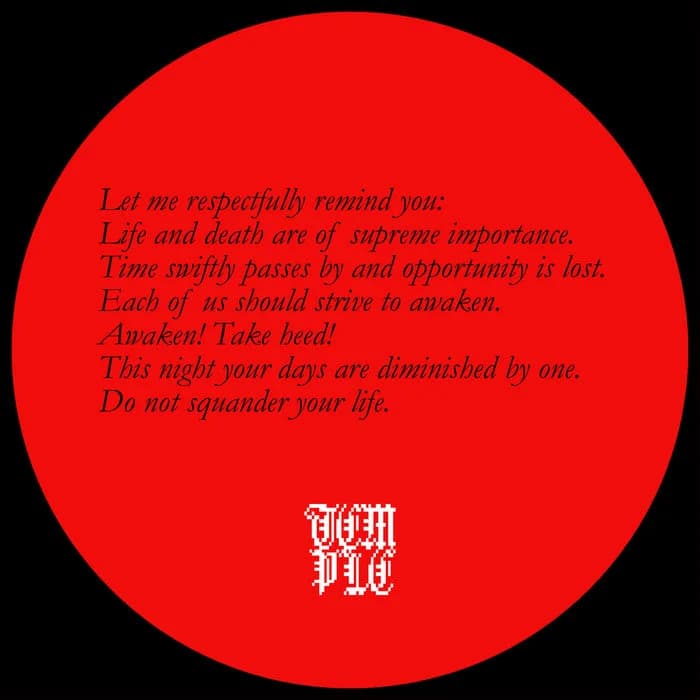
Evening Gatha
by Temple Dance
Susan Mosca (1952–2014) maintained a biographical record largely devoid of deviations. Archival documentation confirms she was employed as a ██████████████████ for thirty-two years in ████████████████. She resided alone in a 640-square-foot leased unit. Financial records indicate she purchased identical groceries at 14:00 every Sunday and maintained no interpersonal relationships, outgoing correspondence, or registered emergency contacts. Evening Gatha is cataloged as having been recorded in the winter of 1987. The exclusive sound source is the Kaelen-Breslin Poly-Kinematic Synthesizer (Model V). A notoriously unstable prototype recalled by its manufacturer, the Model V bypassed analog circuitry in favor of suspended quartz-harmonic oscillators. According to a single surviving operational ledger, Mosca claimed the instrument did not require tactile interaction. It was described as "kinesically receptive," translating the localized electromagnetic shifts of her physical body into audio frequencies during periods of deep, involuntary ████████ states. The ledger mandates that operation exceeding 45 minutes will result in ████████████████████████ within the immediate environment, though it does not specify the nature of this outcome. Mosca's audio output was undocumented prior to her death in 2014. The master tapes for Evening Gatha were presumed destroyed until 2026, when Temple Dance acquired a lot of unmarked BASF cassettes from a ██████████ clearance operation. The tape containing this audio was found sealed inside a hollowed-out Haynes repair manual for a 1981 Honda Civic. The cassette housing was coated in a sterile, unidentifiable ████████ residue. It has been digitized and is presented here in its original, unedited form.